being terminal centric we should be knowing of fathy
maybe also this
I have never understood the hype around Brave. It’s just a nicely advertised Chromium skin with crypto bs. Wouldn’t it be more logical to use ungoogled fork if you want to run Chromium 
The only thing that Brave has going for it is that it’s “out of the box” settings are favorable from a privacy perspective.
Other than that, it is mostly marketing.
Me either. There’s way too many browsers to begin with and 3/4 of them we don’t even need.
The main selling point for me is it’s the only browser with semi-decent ad-blocking on iOS (I have to use an iPhone for work). On Linux I alternate between librewolf and vivaldi.
Just so you know, Orion works on IOS. It’s still in beta, but from my testing it works pretty well for a mobile browser.
That’s false. There are only two browsers, Chrome and Firefox, everything else is just a derivation of those two. You could make a point that there are too many derivations of the same thing, but there can never be too much software.
There cannot be too much choice, and in fact, when it comes to browsers, any choice is just an illusion.
We desperately need a new browser, one that will not be based on Chrome or Firefox. Chrome is just downright evil, and Firefox is getting worse and worse with each release. Both companies, Goolag and Mozilla are utterly corrupt, and they hold a duopoly on this (nowadays essential) software. At this point, Mozilla is just an anti-trust guardian for Goolag, they don’t even develop software.
It’s high time for a new browser engine to be developed, from scratch – that is, not based on Chrome or Firefox. It’s been high time for that for the last decade, but whatever.
The problem is that web has become so complex and so bloated, that even Microsoft doesn’t want to develop a new browser, and sticks to Chromium for Edge.
There are many Free and Open Source projects for browser engines, but none of them are capable of handling the modern web, and this complexity is by design, to keep the barrier to entry high.
We need to revolt against the modern web and create demand for websites to be as simple as possible, using static HTML wherever possible.
Where is the source code?
Not sure if this is a rhetorical question. Just in case it isn’t, Orion is not open-source (yet, at least according to some of its developers)
Good one! Ha! - Ha! 
In that case, it is almost certainly spyware.
My gut tells me that yet is just a way to placate its users who demanded the application to be open-sourced.
Obviously.
After reading their 
 explanation:
https://browser.kagi.com/faq.html#ossprivacy
My conclusion is: definitely spyware.
Obligatory legal disclaimer: I could be wrong, as unlikely as that is in this case.
just-trust-me-bro-source

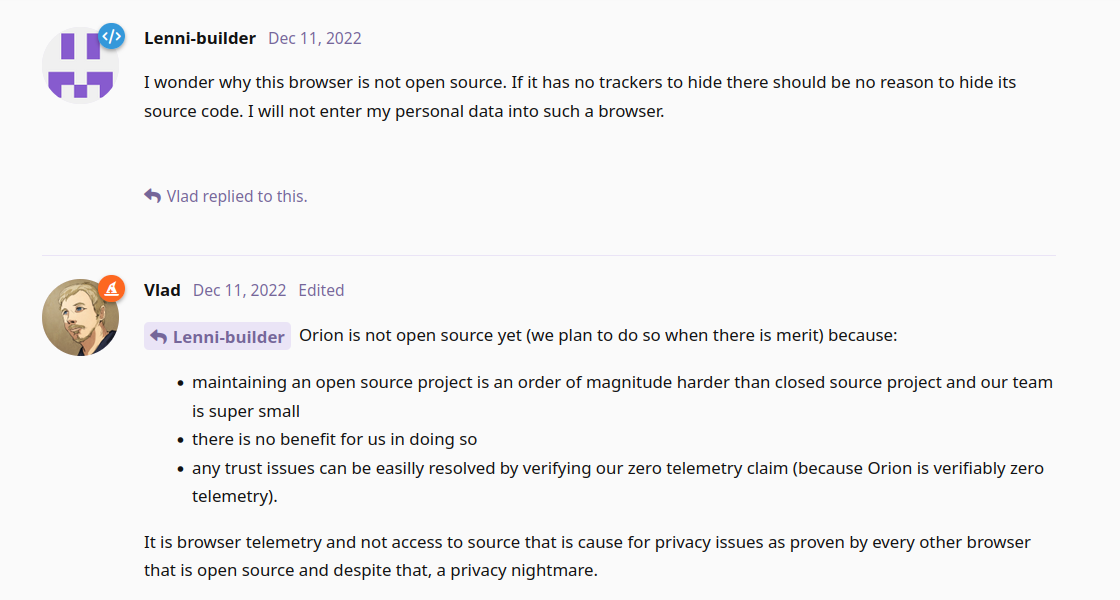
It is exactly just-trust-me-bro-source license.
Just trust me bro telemetry
Hence the “not quite” part, due to the ambiguous interpretation of the whole thing.
It shows that @Kresimir 's claim of it being spyware has some credit. On the other hand, it also shows the just-trust-me-bro-ness of the developer’s reassurance.
All three points are utter :
- Maintaining open source projects is in no way more difficult than maintaining 𝖕𝖗𝖔𝖕𝖗𝖎𝖊𝖙𝖆𝖗𝖞 software. You don’t have to make the development versions open (or share your entire git repo), just publish the source that can be used to compile the binary you already ship. This is how projects like GCC do it. It takes almost zero extra effort.
- Obviously, to them the benefit of users’ trust is less than the benefit of whatever nefarious thing they are up to.
- No, they cannot, even if the browser doesn’t have telemetry, it can be used to steal data, it’s very difficult to verify that with Wireshark (almost impossible, unless you know exactly what you’re looking for).
Which requires access to the source code.
Yeah, it certainly would help. 