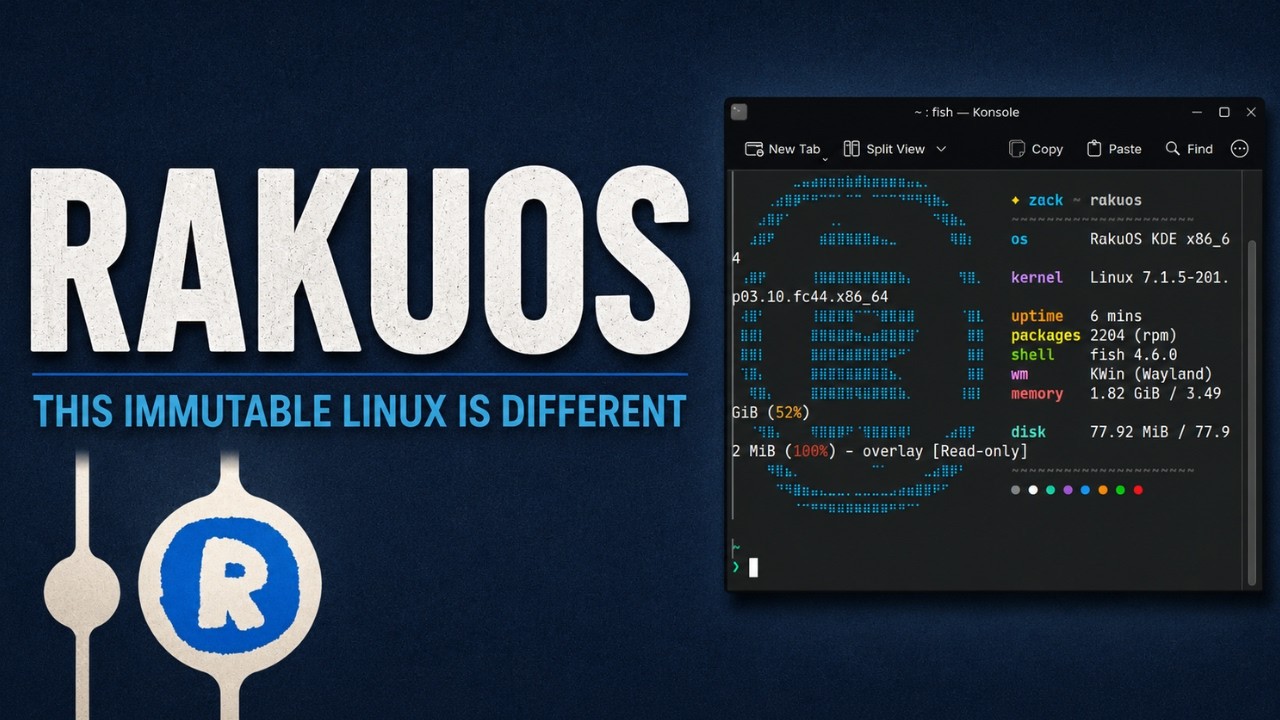
It purports to be a Fedora-based immutable distro with a persistent layer for native RPMs that does live between image updates.
The idea is quite interesting (I watched a video on YouTube) and I think I need to get my hands in it. I love the idea of being able to wipe the persistent layer in a single command and revert to the base state.
Anyone else interested? (Will put the link of the video I watched at the bottom)
Sounds interesting, but I can’t remember when I last time wanted to kill all my applications at once (what about the configuration files in home folders?) and install something different. For now I think it’s not meant for me, but maybe that’s just a matter of needs. Thanks for showing that refreshing concept.
Depending on how it’s implemented, it could be revolutionary (the potential exists, I’m skeptical, but I have it up and running in a VM to check out).
Basically, for me, it would be a machine I could tinker with to my heart’s content and wipe/reset instantly w/o a reinstall, if I broke it catastrophically. I love that idea. And if native performance vs the frustration of overlays breaking the base update have been overcome…well, howdy.
Or that’s what I see…
Breaking things catastrophically is what I used to do, too. But I had to learn how to fix them, and having this one-line-solution is like a time machine… could lead into lazyness or do it the easy way. I would have definetly been a poweruser of that function.
Off-topic: That’s why I think a time machine isn’t a good idea. Someone would ever press “back to dd.mm.yyyy hh:mm:ss”, and there won’t be a future
Oh you’re correct, I’m way past that in my IT/linux life. However, the opportunity to just go hog-wild and not have to worry a bit does look interesting and certainly worth a look at how the technology is implemented.
Edit: Huge letdown, it uses DistroBox to overlay. I believe it maintains a list of packages installed and transparently reinstalls the overlay packages upon an image refresh. I think I see their reasoning, but I am disappointed it’s not something more revolutionary :0
I can assure you its NOT a distrobox overlay, its a Dracut module that runs after the ostree modules and mounts an overlay over /sysroot/usr BEFORE switch root runs thus it becomes an /usr overlay and it mounting this early allows even akmods and dkms modules to be installed and loaded since the overlay is mounted BEFORE systemd starts user land, also Soon will be releasing a native package manger to handle our overlay https://rakuos.org/rum
Yes, and maybe if you made it clear the technology, people wouldn’'t dig and try to find it out and make the wrong assumptions. I want (and wanted) to know, I just went down the wrong rabbit hole, I suppose. This is much more interesting.
Rick, I’m not picking on you..but exactly what are your objections with immutable? Not looking for an argument just an understanding.
I know that you’re basically stuck with the base software load of the image, but if you can add other stuff persistently, as long as you picked an appropriate base (DE included), and configuration is write-able (like /etc), I don’t see much to not be happy about. I probably won’t go the route myself (at least not now), but it does seem like it would be a more than viable option for those less tinkery than ourselves?
Precisely the reason I have no interest in immutable distros.
EDIT:
Though after watching the video, RakuOS does seem to use the idea of an “immutable distro” in a bit of a different way. I must admit, this is intriguing.
There are many reasons. I wouldn’t be using a Rolling release based Arch system if I thought immutable was the way to go.
Most veteran Linux users would say this design restricts deep system customization, forces complex work arounds for software deployment, and it also seems contrary to the open, tinker-friendly nature of Linux.
It has read only limitations. You cannot modify or patch system files directly on the root filesystem without breaking the atomic image paradigm. It has a rigid appliance feel that dictates what the base environment looks like. There is also storage bloat. Containerized application formats like Flatpaks duplicate dependencies and consume significantly more disk space than shared native system packages which amounts to container overhead. They are more restrictive. Read only limitations. There are many more reasons one could give. Broken workflows such as standard command-line tweaks, custom system scripts, or manual file edits in /etc or /usr often fail or vanish during updates.
It’s just not something I’m interested in using. Sure one can argue that you can get around some of these things but I don’t see the appeal. Is it innovation or stagnation?
Edit: I am not an expert by any means. This is just my thoughts on it and others will have different views or opinions and or their own thoughts based on their own experience and knowledge.
I Made it VERY clear its a Dracut module mounting an overlayfs how hard is that? Like We have Forums we have a Discord you can ask someone BEFORE spreading false information just saying.
I looked over the forum and found a paucity of information. It appeared basically brand new with minimal posts.
Calm down. I’m posting about what is, I assume your distro, in a mostly positive light. I did apologize for what I seemingly got wrong. This post was to stimulate discussion and pool knowledge resources.
I shouldn’t have to ask for architectural information. I shouldn’t have to guess either.