i mean… that wouldn’t nuke my distros grub, right?
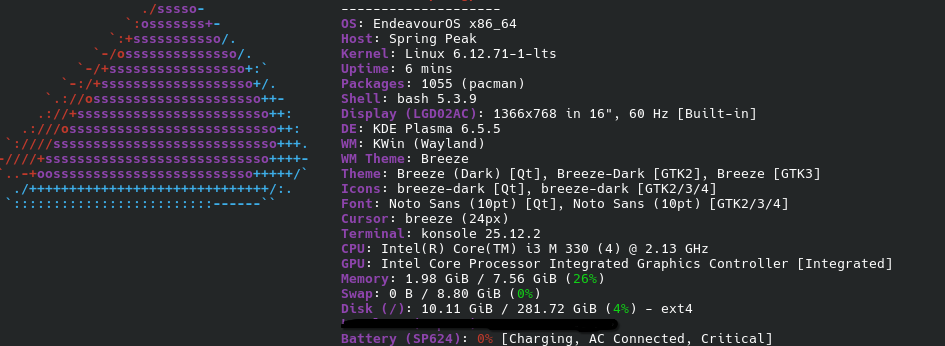
I just did a bit of searching and I can’t even find any info on your machine, let alone BIOS update options.

2 Likes
Same. I wanted to post a link for it, and after 5-10 minutes of looking, I gave up.
@eZepp Your “easiest” route to checking for and getting a BIOS update would be to install a Debian/Ubuntu/Fedora/SUSE-based distro. Those come with years of support.
Or just install and use fwupd from the Arch repos. 
i mean is that old and i still can run video enancher, graphic editor, and stream 1080p without making my fan scream… that’s something 

That’s a tricky balance for developers.
Building hardware optimisation into an application, sometimes comes at the cost of shedding legacy support. I’d suggest that in most cases, compatibility is favoured over optimisation.
Open source software provides the advantage at least, that one can often compile an application themselves, selecting to enable or disable various features and optimisations, improving support for hardware.
Take RawTherapee for example. I use a modified PKGBUILD for that application that sets a number of RawTherapee specific build flags to optimise it (as well as makepkg optimizations). The standard Arch practice for packages though, is no architecture specific build flags, for the purposes of compatibility.
CatchyOS repositories are a rare example I think, of providing architecture optimised builds. But also, made possible by virtue of being open-source.
I agree that open source is an advantage to the user in that they can optimize for their device, thereby possibly reducing the hardware requirements.
However, how many people actually take advantage of this? As you just said, there is a whole distro that does this, and they are an exception. Imagine the individual layman. As far as they are concerned, the app they downloaded simply can’t be changed, and if it doesn’t work out of the box due to hardware requirements, their device is suddenly not good enough for the app.
On the distro note, there are distros optimized for low-end PCs, gaming, etc. Would it be out of place to then expect that individual apps can’t also be optimized for different environments/use cases as well? That is, assuming we are talking about big open source projects with lots of users and funding: Blender, Inkscape, etc.
Krita is criminally underfunded for the number of users it has imho. As are all open source creative apps, but I just wanted to mention Krita.
I think we share similar thoughts on the topic.
My suspicion though, is that generally speaking pre-compiled apps are compiled for compatibility, not optimisation. Opinionated build options are selected based on common use cases.
I speak generally across the board of OS’: Linux, BSD, Windows, Android. I’m not sure about OSX as I have little exposure to it, but I know Apple have tight control over hardware and versioning, so maybe things are different there.
In terms of the topic, at least in the case of NVENC, fallback to a software codec is broadly available, as PC’s without a Nvidia GPU are also common.
Yes, at least it’s not a case of a core feature such as rendering not being usable without higher end hardware.
Not to be dismissive of them, but Apple users, generally, are not my concern in anything open source, and until recently, useful and good quality open source apps were very limited for them. Based on recent additions to AlternativeTo.net, there has been a spike in open source activity for Apple users. So much so that I’m somewhat annoyed because almost every new app being added to the site (like in the last 3 months) is for an Apple device; meaning made either exclusively for Apple or with an Apple-first approach.
This is, of course, a good thing for the world.
It just doesn’t affect me (a non-Apple user) directly.
The spike for reference: https://alternativeto.net/browse/new-apps/
Hmm… it’ll be interesting to see the Stack Overflow developer survey results this year. I wonder if the advent of Windows 11 has pushed a portion of devs to OSX.
But yeah, I share your sentiments regarding Apple.