Just stumbled on this, may interest some of you, but I don’t think I could go back to the late 1990s 
A young person could pull it off. They’d look hip and cool and cool and trendy.
An old guy like me, if I used it I’d just look like I couldn’t handle anything more complicated than an old Nokia. People would pity me.
To be fair, people already pity me…but they’d pity me even more  .
.
Actually looks intresting. But I do not get their android without android thing.
Missing some technical details.
Also quality of keyboard is unknown.
This device runs on the Sailfish OS which is Linux based.
Sailfish OS is an operating system for mobile phones developed by Jolla.
It is Linux-based with AppSupport, a proprietary compatibility layer for Android
and custom user interface by Jolla.
So it runs on Sailfish OS which will run most Android apps.
Pudge
Ah. I know about this os.
Devices never got materialized tho.
I mean the one you can actually buy 
This one looks like region specific. Do not see option to choose a keyboard.
I remember when this came out, a lot of people in the retro hardware and software community were like “what the heck is this?” and I still don’t know exactly why.
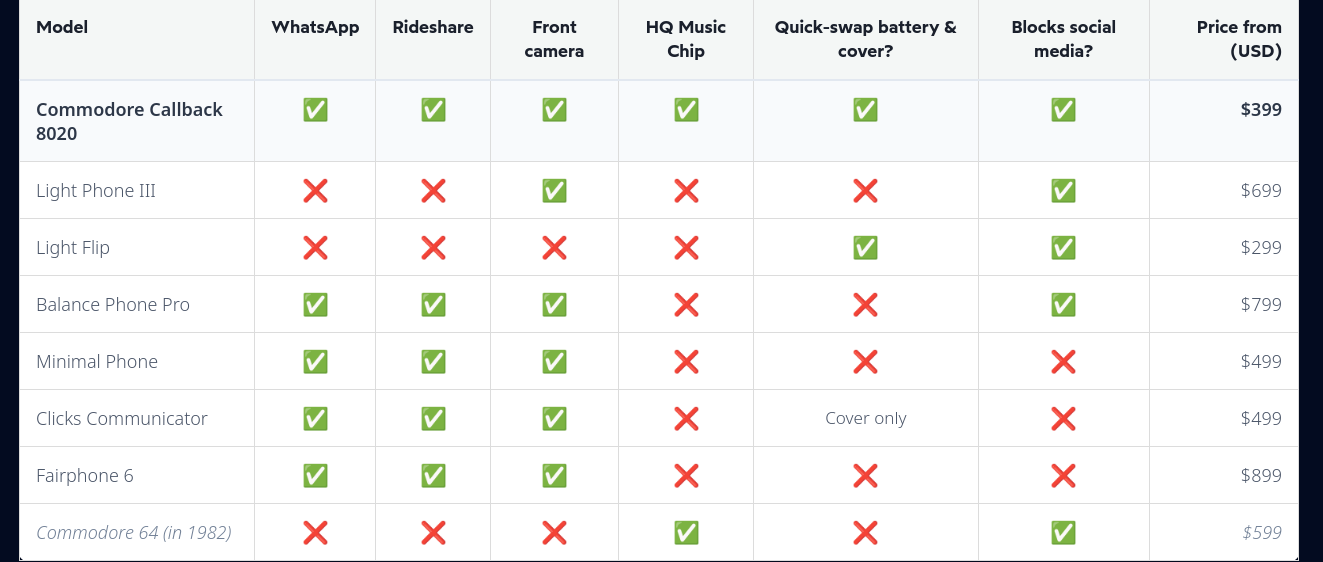
I think I can see why. $400 for a detox phone?
I just noticed they also compare his product to a Fairphone 6, you know, that open hardware and software smartphone that is actually a full featured and is manufactured through ethical means, which demands the higher price, while this is just a standard shitty phone that a Nokia dumbphone can achieve more easily? Yeah… peak consumerism.
Yeah I wonder how much value that would be for the market its made for. Over in my country, if you really want a detox, you can get a basic Nokia keypad phone for as low as (equivalent of) $12. So at least from my perspective, $400 is quite a bit to ask for.
Just for a relative measurement, my current (smart)phone costed me (equivalent of) $215 here.
The price of this and other open-source phones has always baffled me. Yeah, I would like to use one of those, but if I have to pay ridiculous price about phone that doesn’t necessarily come in terms of specs near proprietary ones, I’m not going to buy one.
I get that they don’t have same kind of capacity than “big boys”, but in the end components are exactly same. So that doesn’t explain it to me.
I actually was tempted to buy Jolla when time to upgrade phone became apparent, but the price was over the top, especially considering it’s performance, which isn’t that good. I get that it’s assembled in Finland, and that’s good, but still it’s overpriced.
That’s why I’m using currently Pixel 9a, because if I want, I can put GrapheneOS into it and have phone with good specs with open-source OS.
Same here. You can find old Nokias, that 3310 2017 re-release too and Chinesium dumbphones for ten times less money than this piece of shit. That phone is just pure consumerism. The CEO of the company coming out to do damage control by calling people who don’t get his shitty product indoctrinated just speaks volumes on the amount of thought this actually had put in. It very much is a phone that makes practical zero sense unless you consider “looking cool” a practical use.
I imagine all of these open-source phones are, ultimately, enthusiast phones, made by enthusiasts, who likely care a lot about quality and all of this adds costs. The big boys have large discounts on nearly everything that goes into a phone and are willing to stuff their phones full of pre-installed garbage not because they hate the user, but because most people who buy a phone do genuinely buy into the bait. It’s why Windows 11 is the way it is. Small time manufacturers don’t have discount luxury, especially if you want the phones to have a higher quality, and often outright refuse pre-installing the apps that bring in big cash (take Facebook, for example). Some manufacturers like Fairphone, as far as I know, also want to pay the entire supply chain for the phone decent wages, which costs even more. Manufacturing, getting it to stores, selling and marketing a product costs a lot of money and it is hard to keep afloat and have profit too.
This phone, though, is this expensive more because it can be priced like that, not because it is some labor of love made by enthusiasts. I imagine everything regarding its production and whatnot probably costs less than $200, yet it was originally priced at $500 and price reduced to $400 when people who first saw it thought for one second and realized this phone genuinely stinks at 500 bucks. And even if I was wrong it does cost a lot to make it, it’s clearly more of a lifestyle product than an actual tech product. The software side can be achieved on a normal smartphone too pretty easily and the inclusion of hardware SID support is just… the most unnecessary, odd and stupid possible thing you can add to this type of phone.
I would guess that it’s to try and trigger nostalgia in old time commodore users.
It does have androud apps so not really detox phone.
Idea is intresting. Marketing a bit strage.
This is the main problem with such devices.
1 - marketing
2 - commitment.
Looks like if they unable to generate insane profit this companies just dissaper.
And that’s kind of why I find it a stupid idea. Android allows you to set daily limits on your phone if you want. I imagine iPhones and iPads allow the same time of control. It is, IMHO, a stupid idea and peak consumerism, pushing ideas about reducing digital time into lifestyle like products.
Yes. Exactly this.
No social media, no tracking . . . oh and whatsapp is installed, owned by Meta, one of the biggest tracking companies on the planet.
Apparently (at least according to interview) unlike standard SaifishOS device, this one has a blacklist of what can or can’t be installed.
e.g.: you get WhatsApp, but no TikTok.
I don’t expect that this phone is going to sell numbers close to even the FairPhone. New Commodore loses economy of scale, they need to spread recouping R&D costs over fewer phone and thus need bigger margins.
The main problem is that this isn’t technically a dumb phone. It’s only functionnally a dumphone, thanks to the blacklist. That means they are building a (cheap) smartphone-level hardware, but in very small numbers so it’s going to cost them a lot even before adding the (fat ) margins they’ll need to make profit over such small number of unit sold.
That in my opinion was their strategic mistake. They wanted to surf on C64 nostalgia. Which means a smaller number of units sold to the few Boomers and GenXers that still care. But they went for a smartphone internal which is going to cost quite some. Actual dumb-phone guts would have been probably cheaper.
Note that SailfishOS is much more lightweight than full-blown Android. So perfomance won’t be as critical.
but still you’d be paying for small-scale production smartphone-type hardware, and getting only dumbphone level use out of it thanks to the app blacklist
For the nitty-gritty details around SailfishOS, I’ve written an old explainer on SailfishOS Forums that is still mostly correct.
The short thing is that indeed, it’s mostly(*) a GNU/Linux mobile OS, and it can run “Android App Support” a kind of container similar to Waydroid(**) inside which you run Android apps and they show up as any regular native app.
As I mentionned above, according to interview, in addition the Commodore would have a blacklist system that should limit what one can install on the phone to achieve that “phone detox” (e.g. TikTok is disallowed, whatsapp is the only social networking app one gets).
(*): but usually running atop drivers designed for Android so on most phones it uses libhybris so these drivers could run in the more classical GNU/Linux environment with glibc, etc. instead of musl and whatever else Google uses on Android. The Commodore is one of those Android chipset (but other phones like the Pinephone Pro run pure GNU/Linux upstream kernel and drivers).
(**) The difference between Jolla’s AAS, Waydroid, and Valve’s Lepton, is that they are all AOSP running in LXC, but they all use different adapter to make stuff available from/into that container.
Jolla’s AAS has way to display each app’s individual output on an app-card like the native apps, has support to expose input device and audio devices to android apps (so if you use a bluetooth keyboard or bluetooth speaker they also work), and recently added a plug-in to support direct access to raw bluetooth devices (so it should be possible to, e.g., update the firmware of a bluetooth speaker from its official Android App).
So they selling point is restrictions of whay you can do with a phone.
Y
Yup, that’s exactly how I understood it.
It’s the “self-bondage” detox phone for those who fancy themselves as Odysseus chained to mast of his ship to resist the chant of the sirens.
I can’t find the original interview I was refering to, but the same material is second-hand reported by WIRED in that article:
based on Sailfish’s Aurora Store, letting you download some of the same Android apps available on Android.
(Emphasis mine. I don’t think they are referring to Aurora – which is super popular among the SailfishOS community)
At the OS-level, Simpson says Commodore has “patent-pending” technology that blocks the ability for users to install or side-load internet browsers and social media apps. This is designed to be a distraction-free phone through and through. The company is even pitching it to schools that ban smartphones, so having a way to block the installation of these services is crucial. Commodore has permission from Meta to preinstall WhatsApp, though.
So yeah “We sell you a smartphone, but use black- and white- lists to dumb it down to dumbphone level” IS litteraly the core of their weird pitch.
(Well that, and the fact that using a GNU/Linux based OS is going to have a crapton less tracking that your garden variety Google Android malware OS)
I expect it will go the same way as Valve’s Steam Machine: there’s going to be a small set of users who will definitely buy despite the high price, because it definitely fits their very peculiar use case, but it definitely won’t push big number. Next to it the Fairphone is probably going to look like a runaway success. (I mean they sold 30’000 Commodore Ultimate and that was way more than they expected. I presume they are never expecting to sell more than 50’000 phones)
I am probably not the primary target audience for that phone (but I am one of those weird people whose strategy is just “don’t install Tiktok if you don’t like it” or “don’t startup slack when you’re not working” and this works for me) and I supose other people on this forum aren’t the audience neither.
Expect I feel like the Steam Machine is immediately more useful and can be a fantastic way someone new to PC gaming can grab and enjoy, or heck, even someone experienced can grab and enjoy the mostly pain free experience. Its biggest issue is the price and most of it is outside of Valve’s control.
This phone doesn’t really have the luxury of saying it costs that much because of external factors because even at $200, this phone is just a handicapped smartphone with extra software that anybody can install/extra settings anybody can do easily and hardware SID support. In my eyes, it is a bad value proposition…
…but as you said above, I am not the target audience. Maybe someone out there looks at it and doesn’t see a scam, but something they might genuinely consider and I can’t exactly fault them too much without looking like a douchebag. Ultimately, if someone genuinely finds this something worth while, maybe they see something in it I don’t.
What would put me off the most, even if I wanted (and could afford) one, is the fact that Christian Simpson (of Retro Recipes “fame”) is not exactly a pauper; he’s a money-grubber and blatantly begs for financial assistance at the end of his videos (or at least he did, I don’t watch them any more), after showcasing his lovely home in California, which most of us could never aspire to.
He also “bought KIT” (presumably a replica), which he re-imported from the UK a while back. That ain’t cheap. How many patreons paid for that, just to watch him gloat …?
It’s just (turned to?) greed, in my book, wanting to profit from overpriced (and probably inferior) products by using a well-known name, a.k.a. “badge engineering”. 
 :
: …
…