I’m sure first thing that would come to mind in that circumstances would be to read comment at /etc/default/grub, that’s very normal scenario for a 
The first thing I would probably do is try the zen kernel, I always try that whenever I experience bad performance.
Then I would notice better performance, so I would try mainline, to compare it with zen. It would be the same, so the problem would be narrowed down to LTS.
And then I’d look up online what the devil is going on with LTS. And probably find that Reddit post, which would remind me: oh yeah, I have a comment in my /etc/default/grub
I use EndeavourOS btw. Why would i need an lts kernel. 
It has been explained to you why, on several occasions, but you seem to be deaf to those arguments, so no point in beating a dead horse.
If mainline works fine for you, keep using it. It’s your system, your rules.
It’s no better. You want lts use ubuntu. 
Thank you for your recommendation, I’ll keep using the LTS kernel on Arch.
I don’t use Arch. Much!
Read em and weep! Lts doesn’t cut.
I think users who prefer stable systems would give up some performance to achieve that goal. Those who install LTS over the current versions do that knowingly, that not all new features, compatibility patches for new hardware and performance improvements are not included yet. And those values align with those of servers as well.
I have both LTS and current version installed. I don’t see any difference, which obviously does not mean there is none for others. My point is, the difference in performance is “probably” negligible for those who decide to install the LTS Kernel on their own, as the default Kernel is the current one on EndeavourOS or Archlinux in general (right?). According to this users reply Clarification: The linux-lts kernel is aimed at Server usage by its maintainer - #32 by keybreak , there can performance and stutter issues. It probably depends on the hardware and drivers anyway.
If anyone here can point to specific reproducible differences, I would like to test and confirm this myself. Edit: Ah, just while I was typing a link was posted above me. I will look into (but think read that before…).

1 Like
Whats the problem? Why the clownface reply?
Because i’m a  ?
?
P.S. It’s not targeted to you, but the overall confusion in this thread.
Ah, okay. I took it as an offense, because I linked to your answer. Well I don’t know you guys too much yet, so totally misinterpreted it. Well … guess it worked. 
Clowns are always confused.
Not sure why some people keep calling the (latest) stable kernel mainline.
There is no mainline kernel in Arch official repos:
https://wiki.archlinux.org/title/Kernel#Officially_supported_kernels
The mainline kernel has only release candidates and is currently at 6.8-rc5
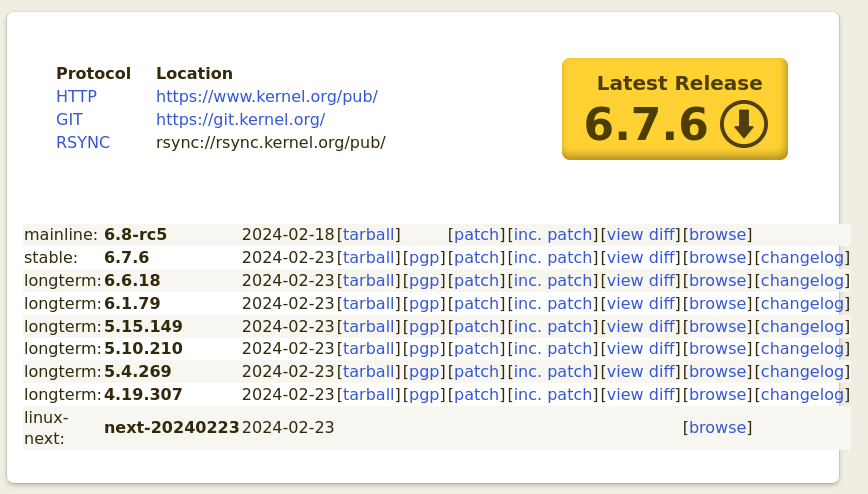
Stable
After each mainline kernel is released, it is considered “stable.” Any bug fixes for a stable kernel are backported from the mainline tree and applied by a designated stable kernel maintainer. There are usually only a few bugfix kernel releases until next mainline kernel becomes available – unless it is designated a “longterm maintenance kernel.” Stable kernel updates are released on as-needed basis, usually once a week.
https://www.kernel.org/category/releases.html
When i used Mint i always updated to every mainline kernel from rc1 through sometimes rc13 until the next stable kernel came out. It was approximately every 2 weeks and i never ever had any issues.
I think only Manjaro provide the mainline kernel in its official repos for arch based distros.
linux-tkg has reacted to this topic as well. The project now provides the same full preemption through out all kernels.
So, all kernels are server kernels now?!? (I admittedly don’t understand all of that)
But the changes made to the wiki yesterday would imply that the lts is specifically a server kernel is clearly not true as it’s been the most stable desktop experience for years now, and that doesn’t change anything because one guy decided to add a quip yesterday. This all seems like an exceedingly poor decision. It’s worded even worse, and should say something like “better suited for servers”, than “targeting usage in servers” as any longer supported kernel would make sense for that anyways. That wording will keep people who should be using it from doing so thinking they don’t have a server. The stable kernel at regular intervals literally just at some point moves into the lts role as far back as I can recall - IE 6.6.x to 6.7.x, so unless the stable kernel is ALSO “targeting usage in servers” it doens’t seem to make sense how the lts wasn’t targeting servers until that very moment. . . Logically there’s a flaw in there somewhere I’m not getting or I am missing that also changes when a stable kernel hits the lts stage. I admittedly am not a kernel maintainer, so I won’t try to say I know what’s happening. I’m really just curious about all of this, since this a brand new concept to me. Maybe there’s just something else I’m missing and I don’t know going on.
What makes that specific point release special and delineates “desktop focused” usage from “server focused” usage? And why is the server kernel arguably the better experience for many, if not, most people than the kernel actually designed for desktops? And why has this never been addressed until now - it was literally changed in the wiki yesterday, and the lts has been an option for as many years back as I can remember. What changed? - Also @BS86
If you’d actually read this thread and read the links provided in it, you might get some basic understanding.
This is what was added to the wiki:
…with configuration options targeting usage in servers.
That does not say “only intended for servers” - it says that it has some optimizations that are targeted to servers. There are (unofficial) kernels that are targeted to gaming; that doesn’t mean that they only work for playing games.
The “one guy” who “added a quip” specifically asked the maintainer of the linux-lts kernel if it was optimized for server usage, and the maintainer replied that it was indeed, and told the “one guy” to feel free to add that to the wiki.
Feel free to diff the configs to see all the differences, but the main difference referred to in this thread, which was specifically referenced in the question to the maintainer, is that dynamic kernel preemption is not enabled in the lts kernel.
Stop saying the lts kernel “is only for servers” - that is not what is written in the wiki. You’re making a huge mountain out of a tiny detail of a molehill.
It isn’t. From a performance standpoint, it is at best equal to the stable kernel, and for some (including me) there is a noticeable decrease in performance under certain circumstances when using the lts kernel.
Some people are afraid of potential bugs and kernel regressions, so they use the more static lts kernel to help avoid that. Oddly, some of those people who insist that the lts kernel is “the better choice” also say that fixed-release distros have “stale” packages, so they don’t use them - kind of strange  .
.