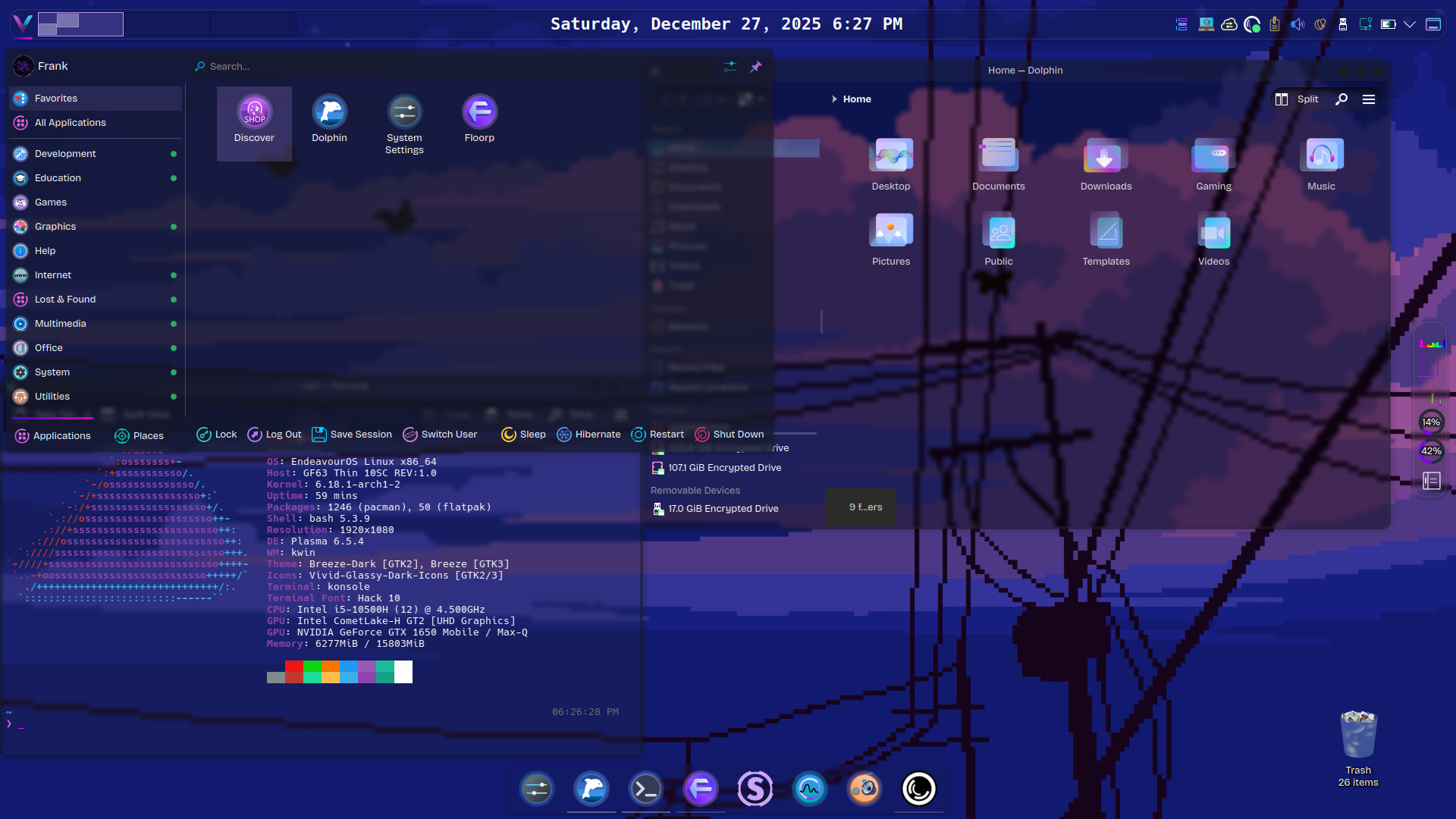
Hi there sorry I wasn’t sure what category to choose, first of all merry Christmas to everyone I hope good holidays for everyone.
So as we all know we are getting closer to 2026, 2025 for me was a good year because I distro hopped 19 times lol. I started using Linux last December of 2024 and started with Linux Mint.
My question is should I choose EndeavourOS over Fedora for my challenge of “No Distro Hopping for 2026”?
I did used EOS before I also used Fedora before, I personally love EOS more than Fedora because I love the community here and the access of the AUR.
Now I also used Debian distros like Mint, MX, Debian itself, Zorin, and KDE Neon. But I just don’t like Debian because it got tons of old packages and its just doesn’t click for me to work with old and outdated stuff, I love updated, fresh software that’s why I think either Fedora or Arch based (Like EOS) might be great pick for me.
Now I did used Arch in the past for longer than any distros I’ve used, and I loved it, I started with EOS first then to Manjaro then to pure Arch and then did quite a lot of distro hopes again and here I am settling down and setting my new home for 2026.
Keep in mind I also configured btrfs with snapper for rollbacks just in case where something went wrong because yea this is Arch.
So what do you say I should go with? Fedora or stay here on my EOS?
And do you think I will be successful in this challenge with EOS throughout 2026?
Welcome! Nine times out of ten, when you’re actually distrohopping, what you’re actually doing is trying new desktop environments. Find a platform that works for you, and stick with it. Only you can choose what that is, sadly we’re not psychic and have no ability to predict your behaviour. It’s a tool not a religion, - again, use what works for you
Using it by myself for nearly a year now and found my new home. I like the lightweight arch base without doing everything from scratch besides being flexible, too.
I like the welcoming and helpful community in this forum.
Why should I waste my freetime with searching when I found what I need.
thanks, but i got a question have you ever encountered any boot issues or other major issues where it will affect your productivity here on the EOS? because thats what i am so scared of.
That’s why you learn how to maintain your distro and setup safety measures (like a dependable bootloader and maybe btrfs with rollback). Heck, you could dual boot two different unrelated distros (I do), just in case of something catastrophic.
And mindset is what you make of it. It’s not a gift that some people have and some don’t.
Never have I had a single problem that made my system unusable. Not on EOS and not on Arch.
This is across many installs and many years.
The bad press Arch gets for breakage is completely unwarranted in my opinion. EOS isn’t going to spontaneously combust and break your system. The core problem is that Arch doesn’t have as many guard rails as some other distros. So if you act without care or you type in commands that you got from chatgpt without taking the time to understand them, it is easy enough to break your system.
That being said, what I do see on Arch-based distros is that application breakage can happen more often. This is for two reasons.
Arch gets package updates faster than a lot of other distros so if there are bugs in a new software version, Arch users are likely to see them
The rolling nature of Arch means it gets new library versions with normal updates. Many applications aren’t always ready to support new libraries as soon as they are released which can cause the application not to work.
These issues are not system breaking and are usually resolved fairly quickly.
Absolutely, but there-in if mission critical lies the wisdom of having another distro installed, you can just flip over and go to town. And probably in a couple of hours, your issue will have been resolved.
I used to this but I stopped 4-5 years ago. The reality was, in practice, I was never using the other distros and if I ever had switched over, the distro would have been a year behind on updates.
These days, I don’t think this is needed because there are so many ways to install applications. If a repo/AUR package breaks due to library issues, you can install the flatpak, the appimage, the nix package or the brew package and be up and running instantly. I suppose, if you were really desperate, you could even install the snap.
I run Arch for years without any breakage. I use older hardware and I have settled on my applications years ago (so I don’t experiment with installing apps with which I have no experience). I also keep backups of all important files. Once you out grow the distro hopping stage, your computing life will be easier and more productive.
Speaking for myself only: I don’t like the Fedora installer. I have EOS on my main machine(which I built this year before the price of M.2 drives and memory sticks went sky high). I think EOS is the cat’s meow, the bees’s knees. You should go with EOS.
You got a lot of hints, but to answer your question in the title of this thread:
At the moment I am sitting at the EOS installation with the longest run in my family. It is running now more than 6 years 24/7. The only problems I ever had were related to software I installed on that PC. No boot problems ever …
I used Fedora on and off for a period of time in the past. . . . I think EndeavourOS keeps the lead in so far as the latest software apps and packages. ‘Fedora was great if you wanted to do comparisons with ‘Mint’ or Ubuntu but cutting edge I’d stick with EndeavourOS. Just my 2 cent opinion. . . .
This may sound strange, and may reflect my own learning journey, but I experienced fewer update/upgrade issues with Arch than Fedora (at some point in the past, I couldn’t tell you how many years ago).
Debian based (which was earlier than Redhat/Fedora) were absolute shit for upgrade from one release to the other (imo). It was like Windows, you’re better off reinstalling.