No, I was on Buster until JUST after the freeze, and that’s when Firefox finally upgraded it’s dependencies past where Buster could work without a LOT of upgrades. So if that repeats itself (Firefox SID being able to install with just a few dependencies until Bullseye is months from going oldstable), I see no reason to bother installing in any other way.
Always had a soft spot for Debian myself…ran vanilla Stable for a few years on a laptop and I continue to use a custom Debian-based distro for music production on an older machine. Anyone familiar with AV Linux? Nowadays it’s based on MX Linux, but used to be based on Testing iirc. In the case of old/outdated software, I didn’t/don’t care about that as much on the older machine because I didn’t need the latest-and-greatest, I needed reasonable stability that wouldn’t negatively impact any projects I’d be working on.
Another Debian based distro that is a little more usable for desktop users than straight Debian is Linux Mint Debian Edition with backports enabled. It has that beginner friendly Linux Mint environment, but with the backports enabled, stays much more up to date than Debian or the main Linux Mint version. It’s also not as picky as Debian with respect to software licenses. I’ve never had a backport break anything - very solid. I don’t use it myself much, but I maintain an install for family members that aren’t interested in rolling release or being their own sysadmin. It has served as a gateway drug into the Linux world for several family members. Currently it is on the 5.10 LTS series kernel through the backports, which is only from 6 months ago, so not bleeding edge but modern enough for most current hardware. Without backports, obviously a lot of stuff will end up being as old as the the baseline Debian that LMDE uses. Worth a look if your use case fits.
It’s not my thing necessarily. I just did an install of Debian recently. Apt is just awfully slow in my opinion, but since you don’t update nearly as much it’s not particularly relevant I suppose. I was irritated sudo wasn’t setup by default. But it just wasn’t snappy feeling like Arch is.
It would make a good work distro since it’s so stable though. Debian Cinnamon for the stability!
I did a Kubuntu install recently. And installed some snaps on it. Holy cats was that slow. Like Windows with like 20 pop up ads on start up slow. I don’t understand how that’s usable to anyone.
Given current XFCE’s state I’m seriously thinking of hopping to a non rolling distro. For a long time now, but even more since 4.16 XFCE is so buggy that it affects my workflow. I liked how stable it was before. At some point even the systray icons worked. all this is now maybe more than a year in the past, however with a non-rolling distro I could get back to that past and live in a solid unbroken world.
That sounds a bit strange to me - the XFCE bit, anyway! I am on the newer one, and apart from having to remove CSD from it, have had no problems with new stuff. Maybe investigate in another thread?
I have two main issues, I’ve investigated them and found there’s nothing I can do about :
Some systray icons react to left click as they would to right click. To make matters worse, for some stupid reason holding the click down for more than a tiny fraction of a second acts as a double click, thus, left clicking on a systray icon activates the context menu, then performs a click on the context menu entry underneath the cursor. that is usually the last entry in the context menu which is usually “Quit”. So I often end up closing the app completely instead of bringing it to the front. This happens only for a portion of the systray icons, I’ve researched the problem and it’s caused by some library changes in libappindicator about a year or so ago. until then the icons worked as expected (left click activates the window, right click opens context menu). Nobody assumes responsibility for this, so it’s a “won’t fix”. This affects both KDE and XFCE, didn’t test in any other DE. To name a few popular programs that are affected: Skype for Linux, Slack, Bluemail, Whatsapp for Linux. Each and every one of these are crucial for my communication with customers. Interestingly, transmission-gtk is affected but not transmission-qt. So I am using transmission-qt on XFCE.
Here’s how it looks (i’m only using left mouse button):
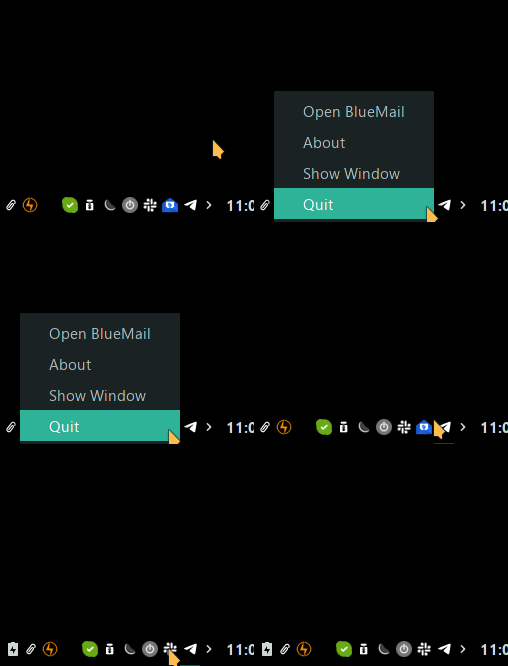
In the last attempt I am holding the mouse button down for a second or more, and the application quits upon mouse release.
The second issue is that the panel sometimes fails to update to reflect the opened windows (so I can’t switch to a minimized window for example), or closing a window does not cause the remaining application buttons to resize and to realign, new windows don’t show in the panel, or their window button is drawn over a preexisting one. This is a bug that is being reported by more than one person on the official xfce repo, but very hard to reproduce, so very hard so fix. It happens randomly. When in such a state I need to run xfce4-panel -r to reset the panel. This started happening around XFCE 4.16
This is how it looks when it’s broken:

And this is how it’s supposed to look (and it does, after a xfce4-panel -r):

*don’t mind the beauty stuff, it’s a site I’m working on for a customer 
I’m not opening another thread since I’ve already researched the issues and was able to find reports of both with no existing solutions.
I guess I just don’t run things with need for that functionality to be uncompromised. Sorry to hear that - especially about the part where solutions are not even planned yet!
Not far enough into coding to help either… too many years ago…
The problem is xfce 4.16 is already making it’s way into the mainstream non-rolling world.
- Fedora, OpenSuse Leap and Ubuntu all have it already
- Debian stable is getting it with Bullseye which is ~1 month away from release
- RedHat 8 and Ubuntu LTS 20.04(and the many distros based on them) are the only mainstream distros that will still have it.
How did you get it 5.22.2 in Debian? Did you build it yourself or is there a repo for that?
I RESPECT Debian, but I am a pure hobbyist, so I don’t need that stability.
I can fully understand running debian (as is usually the case) in science, lab or school environments, or in studios of some sort (as long as the kernel supports the needed hardware of course).
What I don’t get are people using Sid as a rolling release when a proper rolling distro would be much better and more stable at that point.
There is someone who packages it for Testing and Sid via the Openbuild Service. He’s been doing it for quite a long time now.
Is it this guy?
Yes, that’s the guy!
Nothing wrong with Debian. Except older software. 
O Boy…poke me with a tagline…I still like Debian Sid–was testing with it for many years–if I hadn’t had problems with the Dev that maintained the nVidia drivers, I might still be using Sid. But, he really didn’t care about corner cases, so that lead me here.
After messing around a bit more with Debian, adding third party repositories is a bit of a mixed bag…
Roger that! MX was my #1 until I discovered EOS. I still can’t think of anything bad to say about MX. It is a nearly perfect all-purpose desktop with something to offer noobs and old hands alike. If MX had the AUR, I’d still be using it.
Dear fecklesstech,
You have hit the main problem with Debian and the systems based on it right on the head. Having to find and add repos to your installation in order to obtain certain programs which you may want is a major inconvenience and is a ‘pain’ at best.
I do not expect Debian or any of the systems based on it to ever have something similar to the AUR where one can find practically any and every program one would want/need (but, of course, one never knows …) and that precludes me (and many others) from using Debian or any Debian-based system as my ‘main’ operating system.
But MX Linux is really, as I wrote above (and in my opinion), an almost ideal system to introduce a person to the ‘world of Linux.’ Once such a person becomes familiar with the use of a GNU/Linux operating system such as MX Linux, and is comfortable and perhaps is desirous of ‘moving on’ (to a more advanced operating system), then that person could be introduced to EndeavourOS.
But even if a person stayed with MX Linux “forever,” I think that that person would be much better off than if they continued to use either of the two ‘mainstream’ operating systems.
Again, my opinions only …
Lawrence
I was fully prepared to like MX… I had heard good things about it, I knew people that used it, I was familiar with apt based packaging. I installed it, and got the basics going with ease, and was impressed with the ‘User Manual’ information it came with and even with the Conky selection. However, that’s where it stopped… There is very little traffic (or help) available on their forums - and actual usage is somehow ‘off’ - though I can’t seem to pinpoint what it is. Probably just package naming issues and such - but it gets to me! I was saved (in the end) by EndeavourOS  via Arcolinux and bare-metal Arch…
I am with you on MX Linux. I have tried it so many times on both VMs and bare metal. I even used it on my long-term test laptop for a while because I was convinced there must be something I was missing. In the end, I just don’t get it.
It isn’t a bad distro, there is nothing wrong with it, but I didn’t find any killer features that made it special or significantly more interesting than the million other Debian/Ubuntu-based distros out there. There wasn’t a lot to justify all the hype.