I have a PC with a dual core i3-4160 that sits mostly idle for 8 hours a day. It’s my CCTV system but it’s very low resolution video.
I have a spare i5-6500 (quad core) sitting about and want to have a clear out. Do you think this would use up a noticeable amount of extra electricity?
Edit: It’s a straight CPU swap, everything else is equal. Giving the one I don’t keep to a mate.
The cpu is not the biggest energy consumer when the system is mostly idle (a home server for example) The motherboard in combination with the power supply makes much more difference. That changes of course when the system is at full load, but that will be rarely the case with such use.
So if you want to save some extra power get a low power power supply that has a high efficiency at low power delivery (at least 80+ at about 15-20% load) You can check the difference with a power meter directly from mains
Damn I hadn’t realized that. I bought two Dell Optiplex 3020 machines one with an i3 and one with an i5.I bought a better i5 CPU and assumed the other machine was the same. Thanks for making my mind up!
Edit : Doh it’s an i5-4590 not a 6500. I have a bunch of dell machines and I’ve gotten myself confused. But the power consumption point still stands. I’ll Stick in the i5 and get rid of the i3.
Aye I’ve looked at countless comparisons of the CPUs. I hope in reality it wont really matter. All my white goods are cheap and probably very inefficient. I was probably over thinking it tbh.
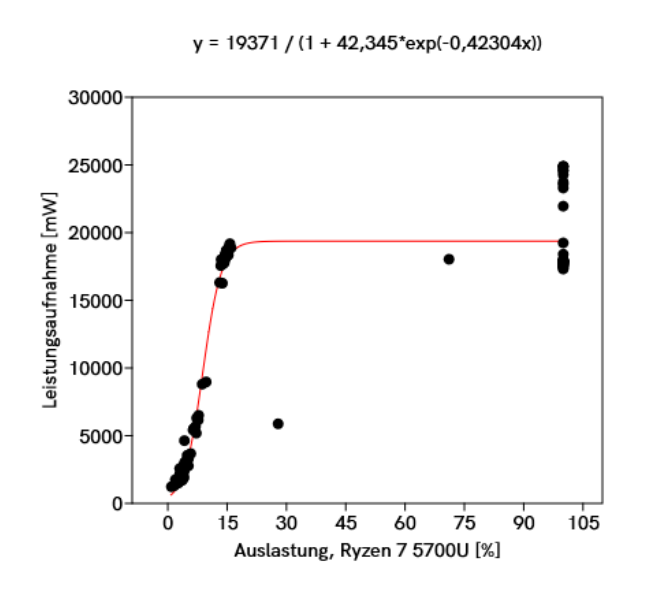
On this CPU power consumption curve, all higher dots are above 15000 (15W).
The stack of dots are from 18 W to 25 W, the red horizontal line is at around 18.5 to 19 W.
This graph and power consumption curve DOES NOT show the TDP whatsoever, because the TDP is not about power consumption. The German term for TDP is: the [required temperature (»Wärme«) dissipation (»Abfuhr«), for achieving a] temperature below the ceiling of a chip, that’s what the TDP is about. TDP is not power consumption, power consumption is not TDP, it’s the temperature below the ceiling of a chip.
What OP is asking about, is the power consumption at idle (that’s the bulk of dots at 0,0 on the bottom left)—again, not TDP.
It’s a good explanation @cc_spicuous and worth grasping what TDP can actually tell us.
In terms of everyday comparisons between CPU options though, one of the only available metrics we have access to that might reflect a CPU’s relative power consumption, is TDP.
It’s not exact because it relates to thermals, not consumption, but the two are related and therefore indicative of each other. The graph you’ve presented illustrates this.
The TDP also represents a max, and doesn’t take into account other CPU and system features that aim to reduce heat generation and power consumption (as you’ve also indicated). I wouldn’t be dismissing TDP as irrelevant to power consumption, if that’s what’s being suggested.
Not at all, consumption is part of the equation, literally as in, a different part in the equation, as in, your physics teacher uses a different Greek letter for that.
I suspect that’s a background process in one of the cores, at the time of measurements—speculation, I have no idea.
By the way, the TDP is different for people in Florida and near the equator, because the surrounding temperature is higher, similarly the TDP in summer is different to winters. Again, … not power consumption.