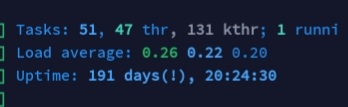
Due to maintenance to the electricity infrastructure in our street, I had to shut down our home server.
It had been up and running for nigh on 192 days, which is a record in our house as far as i remember.
A RPi 4b performs excellently for server use. I have two RPi 4b with 4 GB RAM that run a EnOS base install, so basically Archlinux ARM. They are on a UPS and just do their thing with no problems.
One is a Web server running nginx, noip, and Let’s encrypt and the other is my NAS.
I update them on a monthly basis.
Best I ever had was a radio station broadcasting server, with 470-something days uptime. Running Ubuntu 14.04 I believe. I simply forgot to update it, because everything was running so smoothly…
Fact: i started this setup with an RPI3, running the OS on an SSD. Years later i bought the RPI4, made sure it would boot from an external drive, turned off the 3, disconnected the SSD, connected it to the 4 and turned it on.
It booted without problem.
Does remind me of an Microsoft knowledge base article which stated that a Windows NT? Server needed a reboot every 76 days (don’t remember the actual number) because running it longer would result in an overflow of some register/counter…
Weekly updates with reboot here. If something has an uptime over a week it is usually an oversight or automation failed. Long gone are the days where uptime was a meaningful metric. Uptime = unpatched vulnerabilities.
My home server is also running debian bookworm. Over the last 192 days, back until 27. November, it received linux-image-6.1.0-28 up to current linux-image-6.1.0-37. That is 9 updates. All of them needed a reboot.
The period for the 9 updates i counted started on 15. january. That is 26 weeks for 9 updates. Approx 3 weeks for a new update

 .
.
