Guide how to install and use plymouth

Hello there! I hope it’s okay to post guide made by newbie for newbies :sweat_smile:
But here it is!

Small guide how to setup plymouth in EOS.

I’m nvidia user and don’t know how do it using amd gpu :smiling_face_with_tear:

First of all small plan:

  • Download plymouth
  • Change configs for dracut*
  • Enable splash in boot options
  • Customize plymouth
  • Rebuild initramfs using dracut*

Downloading plymouth

First of all: download.

  1. Open terminal and run
yay plymouth
  1. Select package:
    if you’re using KDE plasma you can install plymouth-kcm (You will be able to change plymouth settings using GUI)
    else install plymouth

Change configs for dracut*

A small clarification: plymouth will work without it, but will appear too late in boot process

  1. Open terminal and create a new config file for dracut
sudo nano /etc/dracut.conf.d/nvidiaload.conf 
  1. Paste inside file:
force_drivers+=" nvidia nvidia_modeset nvidia_uvm nvidia_drm "

Enabling splash in boot options

To see plymouth we need add quiet splash to kernel parameters
System-md:

  1. Open terminal and go to kernel parameters
    Be carefull! Don’t delete or change something!
sudo nano /etc/kernel/cmdline
  1. Add quiet splash after rw
    Снимок экрана_2024-02-20_20-15-59

Nice job we almost done!

Customization!

Plymouth allows you choose and create own themes for boot animations. But in guide I will use theme from AUR.

Non-KDE:

  1. I hope you don’t close terminal? So we will install our theme! Run:
yay endeavouros

Our theme will be near the end

Снимок экрана_2024-02-20_19-47-00
Install it and then

  1. Change plymouth config
sudo nano /etc/plymouth/plymouthd.conf
  1. Insert in config
[Daemon]
Theme=endeavouros

(to list all installed themes: plymouth-set-default-theme -l)
For KDE users:

  1. Go to the system settings and you will found new menu (if you installed plymouth-kcm)
    (Furthermore you can stop following this guide. It settings is pretty easy and has user-friendly GUI)

Rebuild initramfs*

In this guide I will use dracut, because I’m familiar with it

  1. Open terminal and run
dracut rebuild
  1. Reboot

Nice! I hope my guide helps and you actually see boot animation! I decided to make this guide, because I don’t found one in forum (I probably bad searcher) and make it more clear. I will be glad to receive corrections and advice. Have a nice day :slight_smile:

10 Likes

Would be cool to have a Plymouth entry in the Wiki. Thanks for the share :slight_smile:

3 Likes

Does this work on encrypted setups?

1 Like

And for those of us who don’t have nvidia but ati/amd?

1 Like

Use:

force_drivers+=" amdgpu "

Also, if you are using grub, you don’t edit /etc/kernel/cmdline, you make that change to the kernel cmdline in /etc/default/grub

4 Likes

Thank you very much.
Thank you very much for these explanations. This will allow me to install it correctly.

1 Like

Is any optimization recommended for Intel modesetting? Ivy Bridge i5, if it matters…

Probably force_drivers+=" i915 "

I hope it is okay to post here … ?

Tried to install Plymouth that way. I did the following steps.

yay -S plymouth

sudo nano /etc/dracut.conf.d/amd.conf
<--- Add --->
force_drivers+=" amdgpu "
<--- Save and Finish --->

sudo nano /etc/default/grub
--> GRUB_CMDLINE_LINUX_DEFAULT=" ... quiet splash"

sudo grub-mkconfig -o /boot/grub/grub.cfg

yay -S plymouth-theme-endeavouros

sudo nano /etc/plymouth/plymouthd.conf
<--- Add --->
[Daemon]
Theme=endeavouros
<--- Save and finish --->

sudo dracut rebuild

No matter where I add “quiet splash” into the parameters of “GRUB_CMDLINE_LINUX_DEFAULT“, the only thing I get is a Plymouth screen when shutting down the system. When starting the system, nothing is shown.

I don’t have “rw” as a parameter. This is how my parameters look like:

GRUB_CMDLINE_LINUX_DEFAULT='nowatchdog nvme_load=YES resume=UUID=93dc97f2-b21c-4bb6-a58c-6722bd0c17ed quiet splash loglevel=3 modprobe.blacklist=sp5100_tco'

Any idea what I did wrong? :thinking:

When I’ve used Plymouth, I’ve always had quite splash as the last two parameters, I don’t really know if it will make a difference though.

1 Like

Moved both “quiet” and “splash” to the end of all the parameters. But it still doesn’t work on startup. :thinking:

GRUB_CMDLINE_LINUX_DEFAULT='nowatchdog nvme_load=YES resume=UUID=93dc97f2-b21c-4bb6-a58c-6722bd0c17ed loglevel=3 modprobe.blacklist=sp5100_tco quiet splash'

Perhaps point 2.1 of the Archwiki Plymouth could help?

I just installed Plymouth under systemd-boot and it works perfectly. This file can be found in endeavouros as /etc/ostree-mkinitcpio.conf.

To the experts: if I am wrong, please correct me.

I don’t know maybe this is correct since I don’t use Plymouth I do know we use dracut and not mkinitcpio so I’m not sure if that has much affect on your plymouth.

I think you’re right. As a layman, I should probably hold back a little and read the manual properly myself…

/etc/ostree-mkinitcpio.conf belongs to the package ostree which is a dependency of flatpak.

I don’t think it will have any relevance, in this particular case, for a regular Archlinux which may be using mkinitcpio or dracut (in case of EOS).

The file relevant for this case, if mkinitcpio is used, should be /etc/mkinicpio.conf.

Thank you for the explanation.

As I said, as a layman, I should hold back a little. I didn’t remember ever installing Flatpak, but it’s true.

Thank you again for pointing that out.

ps: Since I don’t use Flatpak, I uninstalled it. This also removed the ostree-mkinitcpio.conf file.

1 Like

What is is system-md ?

I tried some more, but I gave up and removed all that Plymouth stuff. It’s ok like it is without that. :wink:

1 Like

Since I uninstalled flatpak and thus also ostree-mkinitcpio.conf and ran dracut again, plymouth no longer works. The Arch Wiki states that I should edit the myflags.conf file in /etc/dracut.conf.d/, but this file does not exist.

Normally in that situation, you create the file.

@MyNameIsRichard Thanks for the tip, I had already tried that without success.

Addendum:

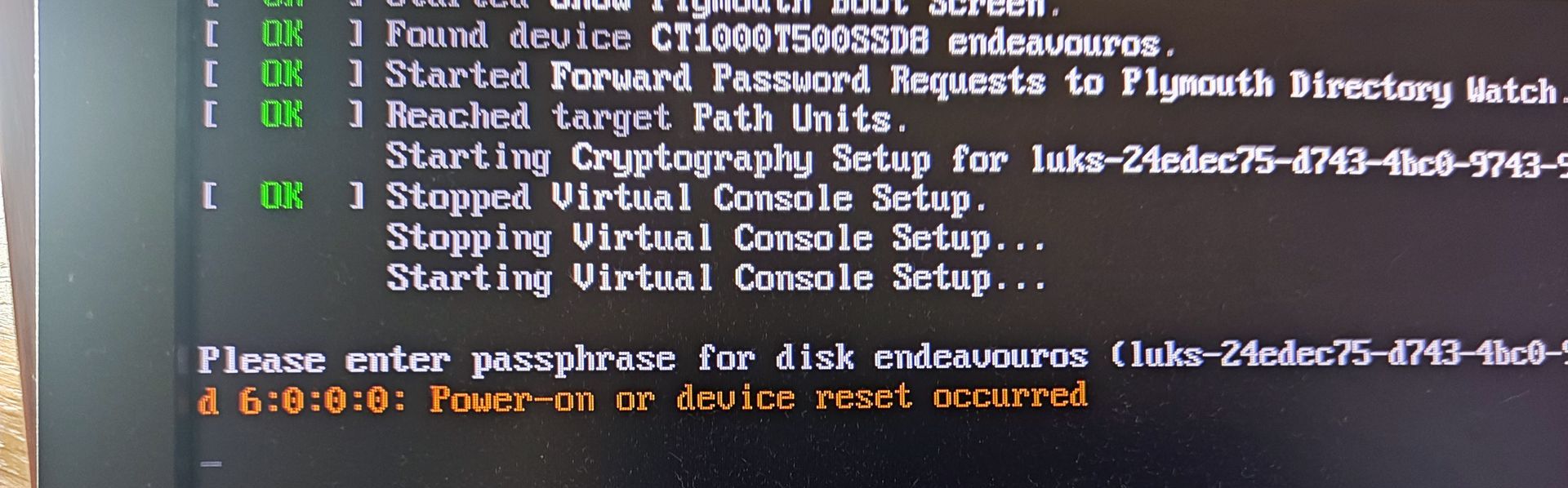
The following message always appeared during boot-up:

Nevertheless, I was able to enter the luks password as normal and the computer worked as expected.

This error message pointed to the Realtek LAN adapter. I then reinstalled the Realtek firmware. As a result, Plymouth now also starts as expected. It seems to be working, but I can’t explain the connection with Plymouth.