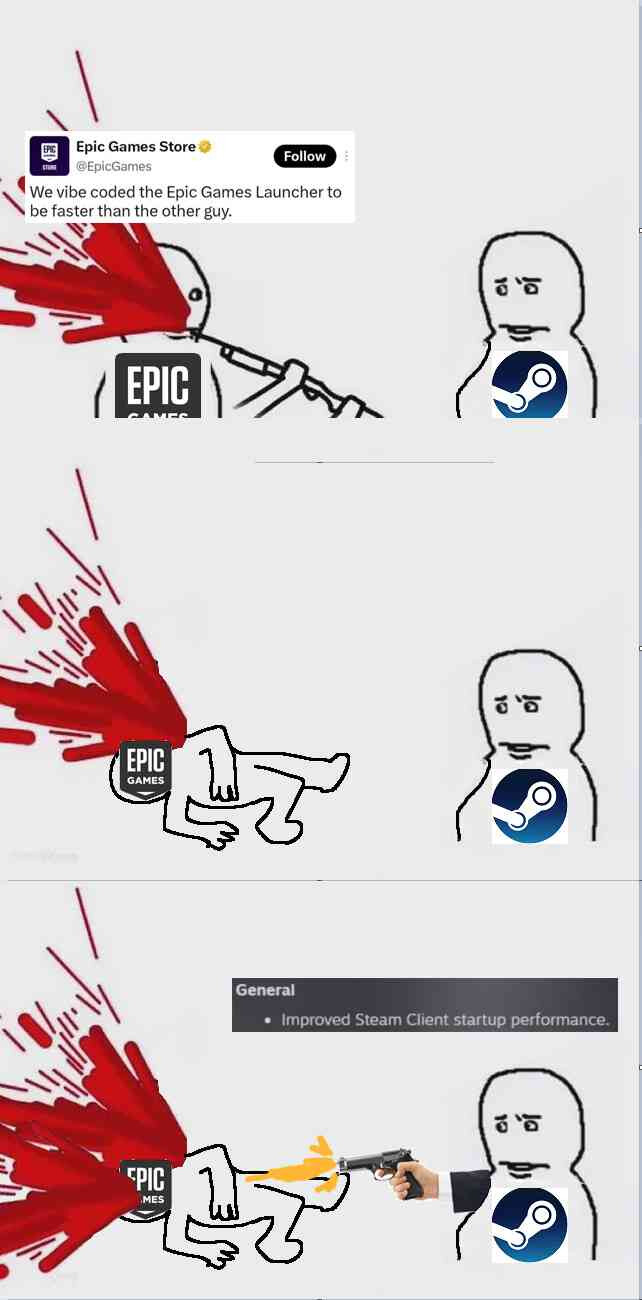
The new Epic Games Launcher is finally here in preview. And it seems that Epic “vibe coded” the launcher. The first sentence surprised me…
Programming is hard. So, instead of doing that, we vibe coded a new Epic Games Launcher.
The new Epic Games Launcher is finally here in preview. And it seems that Epic “vibe coded” the launcher. The first sentence surprised me…
Programming is hard. So, instead of doing that, we vibe coded a new Epic Games Launcher.
Yer a little worrying they lead with that
I think they are doing it on purpose.
They are pushing AI-based and trying to normalize it.
Yer they been doing this for a while now hey, still a bit worrying to me that they normalise it as vibe coding, I get it can be a handy tool but yer..
So secure boot needs to be turned on for it, i wonder how arch/arch based will solve this  . I really don’t care about the epic games launcher since i play single player only and use heroic games launcher for that.
Does secure boot need to be turned on for the launcher, or for the upcoming changes to Epic’s anti-cheat for Fortnite players?
Either way, I think that it is going to put further pressure on secure boot adoption.
Yeah. Seems Arch users may still be screwed. Unless you turn on secure boot after install and self sign secure boot.
Let’s go through the system requirements for EAC Linux v2 one by one. We expect to iterate on these requirements over time, and we appreciate feedback from developers and distribution maintainers to help refine them.
1. Signed Kernel & Kernel Modules
A custom kernel can easily be modified to bypass integrity checks and return false data to anti-cheat. That’s why we require that the kernel binary in use during anti-cheat protected gameplay is signed with a well-known key.
Unlike Windows, most Linux device drivers are part of the kernel source code directly (in-tree) and will be compiled and signed by your distribution alongside the kernel. There are some exceptions that are maintained separately from the kernel (out-of-tree), notably NVIDIA GPU drivers. If you need to load kernel modules, we require that they meet the same requirements as the kernel—being built by an organization and signed with a well-known key.
2. TPM 2.0
The TPM is a hardware feature that provides security primitives like extend-only Platform Configuration Registers (PCRs) which enable a tamper-resistant boot log to be produced and verified. During boot, each piece of the boot sequence (firmware, boot manager, Linux kernel) can record metadata about the code that will run next and update the extend-only registers. This is extremely valuable, because when properly used, it enables an application like anti-cheat to know what code ran at boot without running at boot itself.
TPM 2.0 is standard on modern consumer hardware, and software support is built into the Linux kernel. We require that systems have TPM 2.0 support and that it is enabled in the BIOS.
3. Secure Boot
Secure Boot authenticates the boot chain. Firmware will only execute a boot manager that verifies against a key in its UEFI key database, and the boot manager is expected to validate the signature of the kernel it loads. This prevents EFI-based cheats or others that run during the boot chain. We require that Secure Boot is enabled in the BIOS and only well-known keys are used to boot.
4. Measured Boot
Measured boot is the process of actually recording metadata about the system configuration and code that will run next, then updating the extend-only registers accordingly. Linux boot managers like systemd-boot and GRUB typically perform these measurements automatically by default. Other boot managers may not support them at all or only perform them if a special configuration is applied. We require these measurements to be present.
5. Input-Output Memory Management Unit (IOMMU)
IOMMU is a hardware technology that controls access between DMA-capable hardware devices and physical memory. When fully activated, it prevents hardware cards designed for cheating from accessing a protected game process. For non-handheld devices, we require that IOMMU is enabled in your system’s BIOS and the Linux kernel is configured with IOMMU enabled and passthrough disabled.
6. Kernel Lockdown Integrity Mode
Kernel lockdown is a built-in security feature designed to prevent root from tampering with the kernel. In integrity mode, it blocks root from performing many operations that could be abused for cheating or bypassing integrity checks, like loading unsigned kernel modules, writing to physical memory, or writing to CPU MSRs. We require that lockdown integrity mode is explicitly enabled at boot time.
7. Kexec Disabled
Kexec is a Linux kernel feature that loads a new kernel into a running system without a full reboot cycle. Because parts of the normal boot flow are skipped, measured boot outputs no longer reflect the running kernel or its configuration. This could be abused to load a modified kernel—or change kernel options—to enable cheating without leaving traces in the measured boot log. We require that kexec is explicitly disabled at boot time.
8. Linux Security Module BPF
The LSM BPF feature enables eBPF programs to use Linux Security Module hooks for granular access control and monitoring. This enables anti-cheat to restrict other processes from reading or writing protected game process memory without needing a kernel module, as well as monitor for cheats loaded in different ways. We require the BPF LSM to be loaded and active.
Right, EAC is anti-cheat though so that is probably not a requirement of the launcher.
Only the specific games that use that functionality.
I doubt that will work. It would defeat the point if you could spin up a custom kernel and sign it yourself. It is even mentioned here:
I saw this and got excited at first. However i am now more worried than ever. I like endeavouros. If games switch to this new anti-cheat i will lose access to games unless endeavouros/arch implements the system requirements.
I swear if epic ruins my gaming experience on linux im ganna lose my shit. It sucks bad enough that there are games i want to play that i cant because they outright block linux.
It’s only for games that require EAC.
My most played game of all time currently uses EAC and there is nothing stopping other devs from switching to EAC if this actually “solves” the linux cheating problem.
Apparently, this vibe coded app sucks so much that it is the laughing stock of the entire gaming web. They don’t seem to respect any XDG standard, their “faster than Steam” claim lasted for exactly 5 minutes before Valve updated their client and it wasn’t going to last for more than 15 minutes until someone looked at their God awful Electron slop anyway.
Just use Heroic.
I am a bit worried cause of some games I use to play regularly using EAC. Maybe some time in the future they upgrade to this new v2 of EAC and then I cannot play them anymore cause of the new requirements.
But maybe it is also time then to move on… Earth does not stop to rotate, at least in the time I have left on this planet 
Or as always: improvise, adapt and overcome. 
Let’s see how they wil handle it. We still have valve/steam. For now this is for EAC on epic games and not steam.
I never played games that need EAC. I didn’t play those in Windows and will not play them in Linux, and I will not install anything that needs EAC.
EAC on Linux is in user-space, not in kernel-space.
Okay, so I get to decide whether or not to install EAC applications, right?
Yes you still get to decide what to instill unless it’s a dependency of a game. I was just making sure knew the difference as I wasn’t sure that you knew the difference between how Linux and Windows runs EAC. Because most people here have something against the kernel space anti-cheat but not user-space anti-cheat.