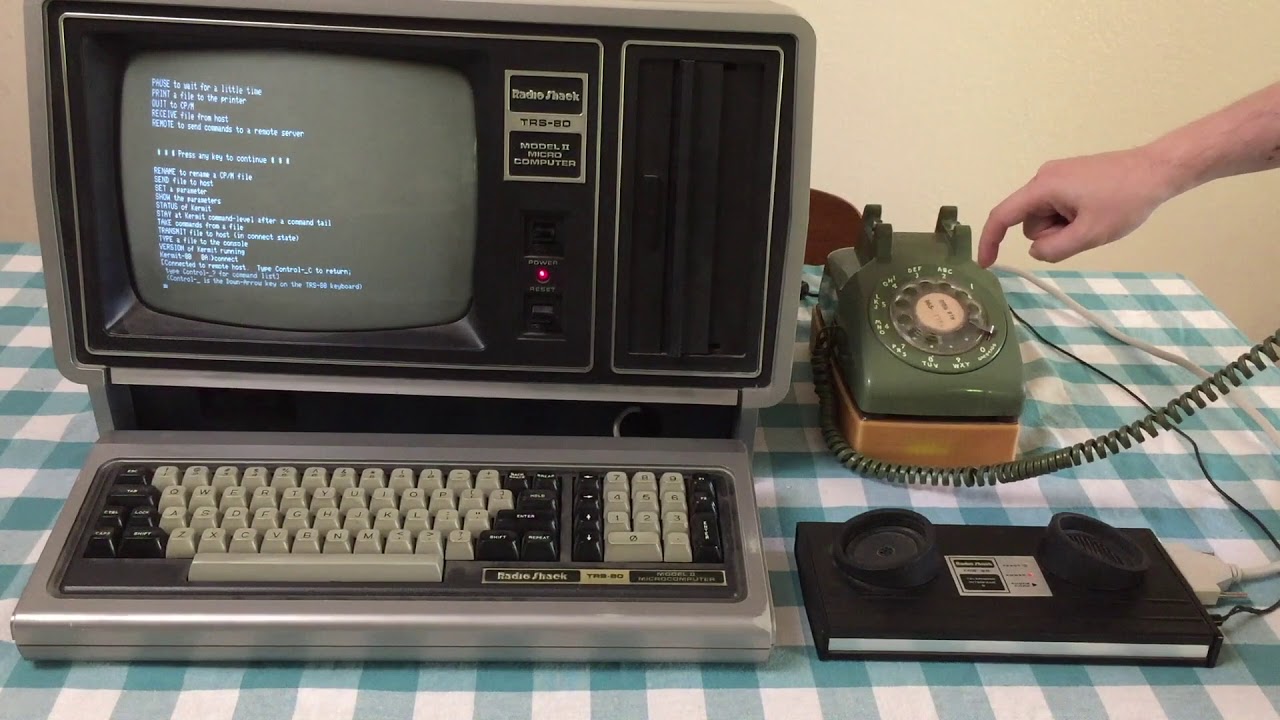
Me too. I had a Western Electric 212A 300/1200 Baud modem. Bought some binary I/O routines to send data between the TI 99 and the modem. Bought a TI 99 expansion box, got a second phone line, then built a TI 99 forum from scratch using TI’s version of Basic. At the end it even had Private Messaging. Aw the good old days.
oh, the fun to no longer have to share a phone line with a 300/1200 baud modem
@pudge, kudos to your forum build with Basic. Most I did was build a spreadsheet to plug in numbers for Federal Tax filing. (overlooking the countless BBS connecting and usenet reading hours.)
Here is a good video for all the youngsters on the Forum.
Except the 212A modem I had was a business modem and with a little help from a soldering iron connected straight to the phone jack, and did by necessity have the answering feature. It was also 300/1200. But I started out with an acoustic 100/300 modem.
My first dabbling with Linux was in 1995 when I bought a book that came with a CD of Slackware, and installed it on my 486 with the umsdos filesystem so I wouldn’t have to make a dedicated partition for it. It was cool to play around with and after a while I finally got X working with fvwm and twm, but I never could get printing or Internet to work.
My first time using it as a daily driver came in 1999, after my Mac clone crashed and corrupted my filesystem and lost irreplaceable data one too many times, and I was desperate for something more reliable than Mac OS 8.1. So I found out about LinuxPPC (an early version of Red Hat compiled for the 32 bit PowerPC processors of the time), ordered a CD of that, and never looked back as long as I had that machine. It came with an early version of KDE, but eventually I switched to basic fvwm or twm to save on memory.
Over the next 15+ years I played around with Knoppix, Kanotix, Puppy, and Debian on and off, but it wasn’t until 2015 (after having Windows 8 for a while, hating it, and finding out Windows 10 was going to be even worse) that I started seriously thinking about using Linux full-time again. I tried LXLE (based on Lubuntu 14.04 but with some nice extra stuff added) on a live USB drive with persistence for a while and liked it enough to make a hard drive partition and install it for real. From there I went to Ubuntu MATE 16.04, Mint Cinnamon (whichever version was based on 16.04), Kubuntu 18.04, and Lubuntu 18.04, but then I started getting bored with Ubuntu (and concerned about the direction Canonical was going such as making snaps mandatory instead of opt-in) and intrigued by Manjaro, Debian, and Arch, and briefly considered ArcoLinux before ending up here.
If you have to update five PCs every half year, including a complete backup of a completely encrypted system, you will finally change to do that only every two years!
Up to 2018 it was never a great problem to update the LTS versions. My familiy and I were happy with that system.
If you do that in your job (as I do sometimes too) it is OK (you get paid for it! ). In my family we want to spent our time together with other things then installing updates all the time.
Mandrake and Suse around 2003. Later tried Knoppix, Ubuntu and a couple of variants. Settled for a while on Mint before taking the plunge into Arch with Antergos. Loved it, and just switched now to EndeavourOS with a fresh install. Thanks for your work.