I’ve never tried CachyOS because the customisations etc. are overkill for my needs. I think you’re right to consider  for your system @maflynn and I hope that your trial of goes well.

I’ve never tried CachyOS because the customisations etc. are overkill for my needs. I think you’re right to consider for your system @maflynn and I hope that your trial of goes well.
Well, the main thing about EndeavourOS is having a system that is basically vanilla Arch with a GUI installer, custom branding and a very healthy community.
I once considered trying out Cachy, but running an OS tweaked towards the newest and shiniest equipment doesn’t do a trick on 7-year-old hardware I own.
I havent tried Cachy, but I know what it means being on a fully customized/preconfigured distro. I started out on Garuda and while I have no complaints about it, it was tough to troubleshoot should you run into an issue, especially if you are a complete newbie.
Excample:
not knowing why you cant download x or y package, as you may not be aware that under the hood you are running chaotic-aur (you dont know what that is).
or once you start customizing, issues with applying themes, as it is already heavily themed → many tools running in the background you are not aware of.
also other many pre-configured things, that are great for performance increase or are nice to have, but you dont understand them and they may cause issues when you try to run something.
I think this could be also applied to Cachy, just with the difference that its not that extremely themed and not running chaotic, but still doing things differently in terms of packages as they get updates sooner which can lead to to problems and confusion.
I think the best thing i ever did in my linux journey was switching to EOS. and trying to understand the differences between Garuda and EOS. Then recreating the good things of Garuda, excample: BTRFS + Bootable snapshots and some design choices, fish, starship etc.
I learned a lot through it and I am very happy about it. In my opinion EOS is probably the best starting ground for new users willing to learn
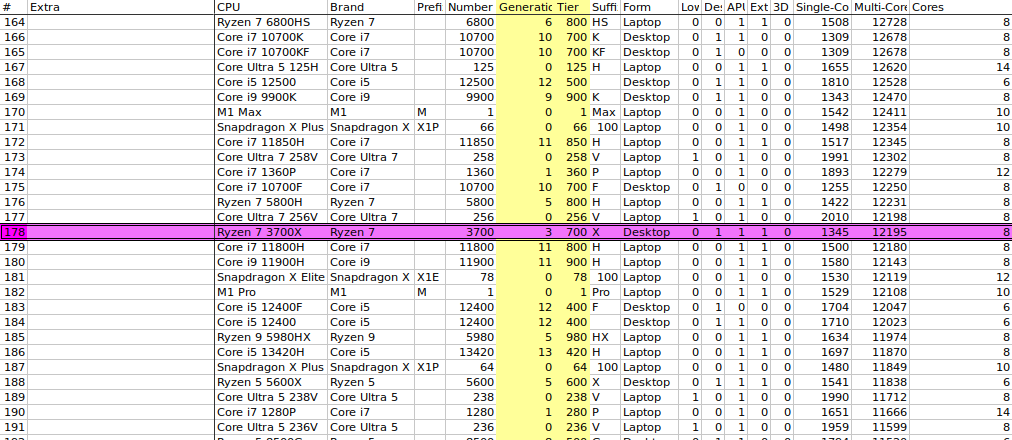
First of all, your processor is not old, or slow. (It’s on par with a Ryzen 9 5980HX and Ryzen 5 5600X.) Many EOS users are comfortable with much slower processors than yours.
yay linux-xanmod-linux-bin-x64v3 oryay linux-xanmod-lts-linux-bin-x64v3are optimized for your processor. During startup, you can then choose whether you want to run the optimized (xanmod .. v3) or generic kernel or lts (long-term support), each and everytime depending on your needs and workload.
Oh, I get that its not old, but I believe it missed the cutoff for the cachyos improvements. I’m very happy with what I have, my point was some of the benefits that CachyOS offers isn’t fully realized on my system. At least that’s what I was led to believe in that it being on the Zen 2 architecture
Not really. One of the reasons why people start to push for these optimizations (in other distros too) is the fact that relevant hardware features were introduced over a decade ago. It’s time to stop assuming a 2002 hardware baseline. The Zen 2 supporting x86-64-v3 is well within the optimization window.
I have nothing to say about the comparison. Welcome to the forum @maflynn
My conclusion when I’ve had a look at it, is the benefits to be gained with x86-64-v4 optimisations, is almost negligible. But sure, on paper, it’s optimised and generally benchmarks better.
x86-64-v3 is even more negligible, to the extent where in many scenarios the difference is essentially none. In the occasional use case, it’s actually worse.
Based on the Phoronix tests though, it would seem the one clear exception to this, is if you’re running PHP code on your system. Realistically, the only time that’s likely, is if you’re running a web-server. One could make a case for web-developers testing code locally, but workstation hardware is likely already leagues ahead of the web-server it’ll ultimately be running on.
GNU Radio has some interesting results, but they’re also a bit of a mixed bag.
I had the exact same experience - and feeling - with CachyOS. On top of that, I’m currently still running an old Sandy Bridge processor (though I’ll be upgrading my system in the next few days to a slightly less ancient i5-8400), so I couldn’t have benefited from Cachy’s optimizations anyway. I think I’ll be better off sticking with EOS in the long run.
for all the comments I think sideways (lateral) is the most accurate. EOS is insanely stable..and this forum. And the prettiest.
If you said Garuda you’d have more varying POVS.
If you said Mabox or Archbang entered the chat you’d be in new ground. EOS is my anchor and I’m new into the Arch (and forks/derivatives) journey. It’s far out.
PS–welcome to the forum
On my main PC, I have a multiboot setup with various Linux distros (currently Arch, EndeavourOS, and Debian 13, which I’d say is my final choice, since I’m tired of distro-hopping).
I’ve had up to two additional distros on my PC. So, a total of five distros, on five different SSDs, on the same PC.
I also had CachyOS on my main PC (AMD Ryzen 7 5700X, 64 GB RAM, AMD Radeon RX 6750 XT with 12 GB VRAM).
I haven’t noticed any major differences compared to the others (Arch, EOS, Garuda, or even Debian). Personally, my PC usage is general, the usual things: browsing, streaming, email, gaming (mostly Steam and Lutris). In short, no specific or professional use. I honestly haven’t noticed any significant differences in gaming with CachyOS; in the end, the real difference between one distro and another is usually a handful of fps (around 5 fps).
Furthermore, I’ve run into problems with CachyOS, likely due to its highly customized nature. After updating the graphics libraries, I’d get a black screen upon reboot. The same update on EOS, which is always installed on my PC, didn’t cause this problem (and hasn’t done so since I’ve been using it, at least a couple of years).
So yes, for me, being more customized can potentially lead to more problems to solve. I’ve chosen the opposite path: fewer problems to solve → better quality of life. Especially for my usage, but I think it applies more generally. Then everyone decides as they see fit.
It appears that you have a AMD 7 3700X Desktop CPU. That was released in 2019 about more than 6 years ago.
If you have been using CachyOS and have not faced any issues with it, I would recommend you stick with that.
If you want to switch to EOS then you will find over here a very helpfull and welcoming arch community. And that I can vouch for. If you run into issues they will help you out. Unlike Arch forums and Arch communities, folks over here do not expect you to be an intermediate/expert in Linux. I am not a CachOS refugee rather I am a Windoz refugee, so cannot compare CachyOS with EOS. EOS runs fine on old hardware. I have done it on an intel box for one of my friends and he is happy with it.
EOS is pretty stable if you stick with the current Linux kernel or the current Linux LTS kernel. If you want to eek out every bit of FLOPs from your setup you can do it using EOS with tweaks.
But this does leads to question. What are you going to do with your AMD 3700X with a AMD 7800XT GPU Desktop? Is it coding? Data crunching? Basic office work? something else?
Some
My desktop is for gaming - sort of light gaming, Bethesda titles, and other stuff like that.
Online stuff, i.e., reddit, youtube.
Home and office stuff, Libreoffice, etc.
Then you should be fine. Would advise you to install LTS kernel along with the mainline Linux kernel.